

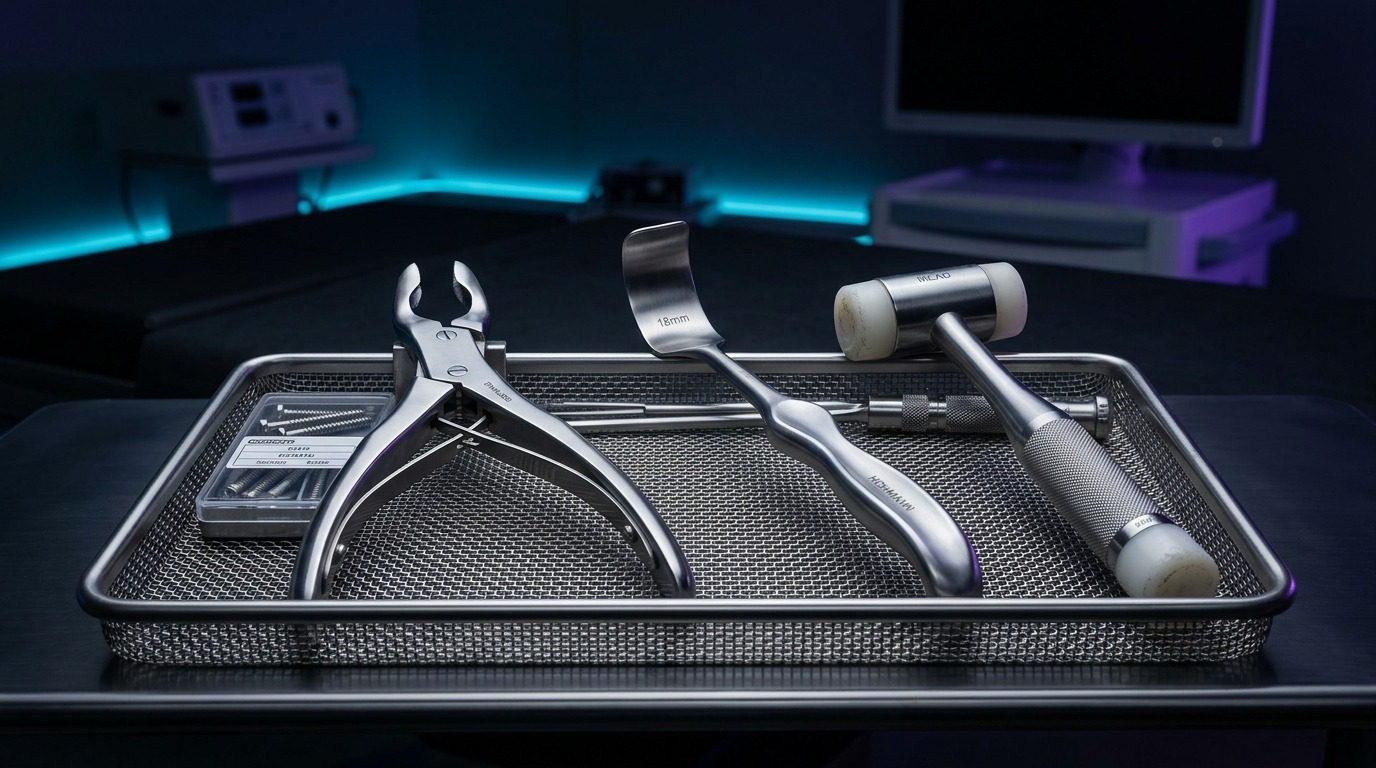
Orthopaedic and trauma surgeries present some of the most mechanically demanding environments in the entire medical field. Unlike general soft-tissue manipulation, procedures focusing on the musculoskeletal system involve navigating dense cortical bone, reducing high-displacement fractures, and installing heavy internal fixation plates. Consequently, the hand instruments utilized by orthopaedic surgeons require an entirely different echelon of engineering resilience, structural mass, and mechanical advantage.
For international medical supply companies, global healthcare distributors, and hospital procurement groups, sourcing wholesale orthopaedic tools is an exercise in risk management. A tool failure during a soft-tissue incision is an inconvenience; a tool failure—such as a bone rongeur jaw snapping or a bone holding clamp slipping—during a high-torque femur reduction can be catastrophic. This professional guide breaks down the essential technical, mechanical, and metallurgical standards buyers must mandate when selecting an orthopaedic instruments manufacturer.
1. High-Impact Metallurgy: Forging Against Stress Fractures
While standard surgical steel performs adequately for delicate cutting and holding, orthopaedic instruments are routinely subjected to high mechanical loads, repeated mallet impacts, and extreme twisting forces. Sourcing premium tools requires looking closely at how the base alloy is treated to survive these harsh demands.
The Single-Piece Forging Standard
For heavy percussion instruments like Lambotte osteotomes or bone chisels, a primary failure point is the junction where the handle meets the shaft. Lower-tier manufacturers frequently weld separate pieces together to cut costs. Under the persistent vibration of surgical mallet strikes, these weld lines develop micro-fractures over time, eventually leading to sudden structural failure.
Premium orthopaedic manufacturing requires that every high-impact tool be forged from a single, continuous billet of premium steel. This ensures that kinetic energy from the mallet travels uniformly down the tool without creating stress concentration zones.
2. The Physics of Double-Action Leverage in Tissue Resection
When a surgeon clips away dense bone fragments using a rongeur or resects a bone shaft using cutting forceps, the manual hand pressure required to shear osseous tissue is substantial. Extended procedures can easily cause hand fatigue and diminish surgical accuracy.
      Single-Joint Mechanism                  Double-Action Compound Hinge
     (Direct 1:1 Force Transfer)                (Multiplied Force Leverage)
             [Hand]                                      [Hand]
               |                                         /    \
             (Pivot)                                  (Pivot) (Pivot)
               |                                         \    /
             [Jaw]                                       (Pivot)
                                                            |
                                                          [Jaw]
   Result: Requires high hand force.          Result: Multiplies input force,
   High user fatigue over time.               smooth and effortless bone bite.
To optimize performance, elite orthopaedic tools—like the Ruskin Bone Rongeur or Liston Bone Cutting Forceps—utilize a compound, double-action hinge mechanism. This complex configuration features two interlocking pivot joints working in sequence.
As the surgeon closes the handle, the secondary pivot points shift the mechanical advantage, exponentially multiplying the output force delivered to the cutting jaws. For procurement officers, verifying the precise machining of these dual joints is vital; they must operate smoothly without any horizontal play, ensuring a clean, definitive bite through bone every single time.
3. Surface Stabilization and Non-Reflective Ergonomics
Operating room configurations for major joint reconstructions and trauma cases feature ultra-bright, multi-directional overhead surgical lamps to illuminate deep cavities. However, this intense light presents an ergonomic challenge when hitting highly polished metal surfaces.
The Shift to Satin and Matte Finishes
While mirror-polished finishes offer excellent chemical cleaning advantages, they create high-intensity geometric reflections that cause eye strain for surgical teams working under magnification loupes. Top-quality orthopaedic instruments are increasingly specified with a fine satin finish. This finish is achieved via controlled abrasive micro-blasting, creating a micro-textured surface that scatters light evenly, eliminating distracting glare while preserving the underlying chromium passivation layer.
Medical-Grade Nylon Cap Integration
In modern bone manipulation, traditional pure steel mallets are systematically being replaced by balanced compound instruments like the Mead Style Mallet. These feature front and rear faces fitted with threaded, high-density, medical-grade nylon caps. The nylon material serves a critical engineering purpose: it absorbs the high-frequency vibration of impacts, reducing the recoil shock transferred to the surgeon’s arm while significantly dampening acoustic noise in the operating room.
4. Stability and Fixation: Sourcing Secure Bone Clamps
During fracture repair, internal fixation plates must be screwed into place with absolute structural precision. To achieve this, bone fragments must be held perfectly immobile using bone clamps or calipers, such as the Lane or Lowman designs.
The key parameter for an effective bone clamp is tension retention under load. Cheaply made clamps often experience subtle teeth slippage or ratchet failure when locked tightly around a slick, wet bone shaft.
Premium manufacturers address this by machining aggressive, deeply grooved, interlocking tracking bars and heavy-duty, multi-stage ratchet catches. Furthermore, the jaw profiles are carefully calculated to wrap around standard anatomical diameters, distributing holding forces safely over a wider surface area to avoid damaging the delicate periosteum (the vascular tissue covering bones).
5. Ensuring Compliance and Sterilization Integrity for Export
Because orthopaedic instruments are deep-tissue invasive devices that frequently come into direct contact with bone marrow spaces, international regulatory agencies audit these shipments with extreme scrutiny.
ISO 13485 Validation
Any manufacturing facility exporting to high-value markets across the Americas, Europe, or the Asia-Pacific region must operate under a fully audited ISO 13485 quality management system. This guarantees that every step of production—from checking raw material mill certificates to monitoring chemical passivation baths—is thoroughly documented.
Resistance to Intergranular Corrosion
Orthopaedic tools routinely face aggressive cleaning protocols involving enzyme detergents, ultrasonic baths, and high-temperature autoclaving. Sourcing from an elite manufacturer ensures the tools undergo verified thermal passivation processing. This process completely eliminates surface-bound free iron and prevents intergranular corrosion—the invisible chemical decay along grain boundaries that causes cheap instruments to rust from the inside out.
Conclusion: Balancing Performance and Supply Chain Efficiency
Sourcing wholesale orthopaedic instruments requires shifting the focus from simple unit costs to calculating the total cost of ownership. Substandard tools result in frequent hospital returns, damaged supplier relationships, and elevated liability risks for distribution brands.
Partnering directly with a specialized, modern manufacturer that prioritizes single-piece forging, compound double-action joint physics, and verified chemical passivation gives your distribution company a major market edge. Delivering durable, high-performance bone surgery instruments at a sustainable cost structure allows your business to win long-term hospital group procurement contracts and thrive globally.